Implementation of 3D Educational Games in Japanese Language Learning for Almuslim University Students with Unity Engine Using Multimedia Development Life Cycle (MDLC) Method
Keywords:
game edukasi, Animasi-3D, Pembelajaran bahasa Inggris, unity engine, MdlcAbstract
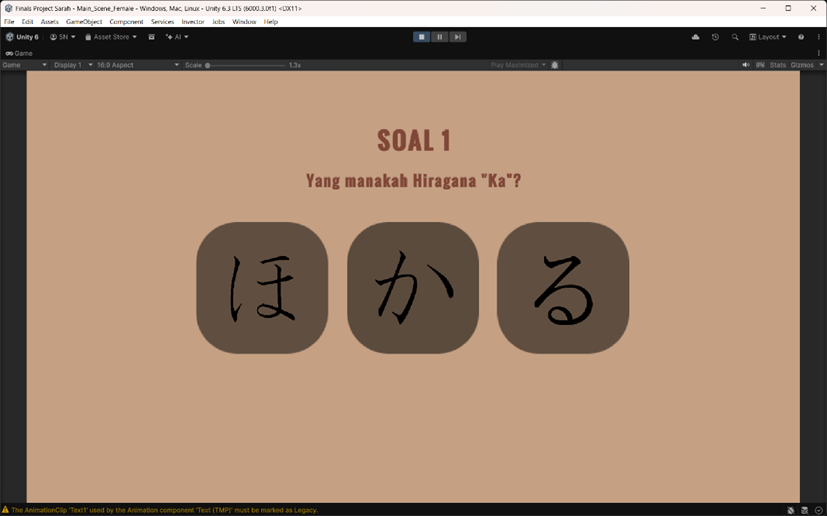
This study aims to develop a 3D educational game as an interactive learning medium for Japanese language learning at Universitas Almuslim using the Multimedia Development Life Cycle (MDLC) method and Unity Engine. The research employs six MDLC stages: concept, design, material collecting, assembly, testing, and distribution. The game, entitled "Nihongo Quest," presents N5-level Japanese vocabulary and characters (Hiragana and Katakana) within an interactive 3D environment. The development utilized Blender for 3D asset modeling, Visual Studio Code for C# scripting, and Universal Render Pipeline (URP) for visual optimization. System testing was conducted using black box testing across 10 functional features. The results show that all tested features passed successfully, demonstrating that the game functions as intended. The game provides an interactive and engaging learning experience, making it a viable alternative learning medium for students who struggle with traditional Japanese language instruction.
Downloads
References
[1] R. Nurcholis, A. I. Purnamasari, A. R. Dikananda, O. Nurdiawan, and S. Anwar, “Game Edukasi Pengenalan Huruf Hiragana Untuk Meningkatkan Kemampuan Berbahasa Jepang,” Build. Informatics, Technol. Sci, vol. 3, no. 3, pp. 338–345, 2021.
[2] M. Sulehu, “Pengembangan game edukasi berbasis augmented reality sebagai media pembelajaran aksara Jepang,” Jurnal Minfo Polgan, vol. 12, no. 2, pp. 2671–2685, 2023.
[3] A. P. Laksono and M. Maimunah, “Aplikasi Pembelajaran Dasar Bahasa Jepang Berbasis Android,” PIKSEL: Penelitian Ilmu Komputer Sistem Embedded and Logic, vol. 4, no. 1, pp. 1–16, 2016.
[4] D. Nugraha and W. A. Maulana, “Rancang Bangun Pengembangan Aplikasi Pembelajaran Aksara Sunda Untuk Madrasah Ibtidaiyah Berbasis Multimedia,” Cloud Information, vol. 1, no. 1, 2015.
[5] L. D. Pratama, W. Lestari, and A. Bahauddin, “Game Edukasi: Apakah membuat belajar lebih menarik?,” At-Ta’lim: Jurnal Pendidikan, vol. 5, no. 1, pp. 39–50, 2019.
[6] W. Wibawanto, Game Edukasi RPG (Role Playing Game). Wandah Wibawanto, 2020.
[7] S. Sintaro, R. Ramdani, and S. Samsugi, “Rancang Bangun Game Edukasi Tempat Bersejarah Di Indonesia,” J. Inform. dan Rekayasa Perangkat Lunak, vol. 1, no. 1, pp. 51–57, 2020.
[8] D. Zou, Y. Huang, and H. Xie, “Digital game-based vocabulary learning: where are we and where are we going?,” Comput. Assist. Lang. Learn., vol. 34, no. 5–6, pp. 751–777, 2021.
[9] R. Zhang, D. Zou, and G. Cheng, “Learner engagement in digital game-based vocabulary learning and its effects on EFL vocabulary development,” System, vol. 119, p. 103173, 2023.
[10] R. Andari, “Pemanfaatan media pembelajaran berbasis game edukasi Kahoot! pada pembelajaran fisika,” Orbita, vol. 6, no. 1, pp. 135–137, 2020.
[11] S. A. Baba, H. Hussain, and Z. C. Embi, “An overview of parameters of game engine,” IEEE Multidisciplinary Engineering Education Magazine, vol. 2, no. 3, pp. 10–12, 2007.
[12] J. Park and C. Park, “Development of a multiuser and multimedia game engine based on TCP/IP,” in 1997 IEEE Pacific Rim Conference on Communications, Computers and Signal Processing, PACRIM. 10 Years Networking the Pacific Rim, 1987-1997, IEEE, 1997, pp. 101–104.
[13] M. S. N. V Jitendra, A. S. Srinivas, T. Surendra, R. V. Rao, and P. R. Chowdary, “A study on game development using unity engine,” in AIP Conference Proceedings, AIP Publishing LLC, 2021, p. 040001.
[14] M. A. Wonggo, J. Waworuntu, and T. Komansilan, “PENGEMBANGAN MULTIMEDIA INTERAKTIF PEMBELAJARAN ANIMASI 2D BERBASIS MOBILE UNTUK SISWA SMK,” Edutik : Jurnal Pendidikan Teknologi Informasi dan Komunikasi, vol. 1, no. 4, 2021, doi: 10.53682/edutik.v1i4.2070.
[15] R. Prabowo, A. Afifah, and azzah Roudhoh, “Klasifikasi Image Tumbuhan Obat Sirih dan Binahong Menggunakan Metode Convolutional Neural Network (CNN),” Jurnal Komputasi, vol. 10, no. 2, 2022, doi: 10.23960/komputasi.v10i2.3178.
Downloads
Published
How to Cite
Issue
Section
Categories
License
Copyright (c) 2026 Aceh Journal of Computer Science

This work is licensed under a Creative Commons Attribution-ShareAlike 4.0 International License.
This journal is an open access journal that provides direct, barrier-free national access to the full text of all published articles without any cost to readers or their institutions. Readers are entitled to read, download, copy, distribute, print, search, or link to the full text of all articles in the ILKA Journal. This journal provides open access to its content on the principle that making research freely available to the public supports greater global knowledge exchange.